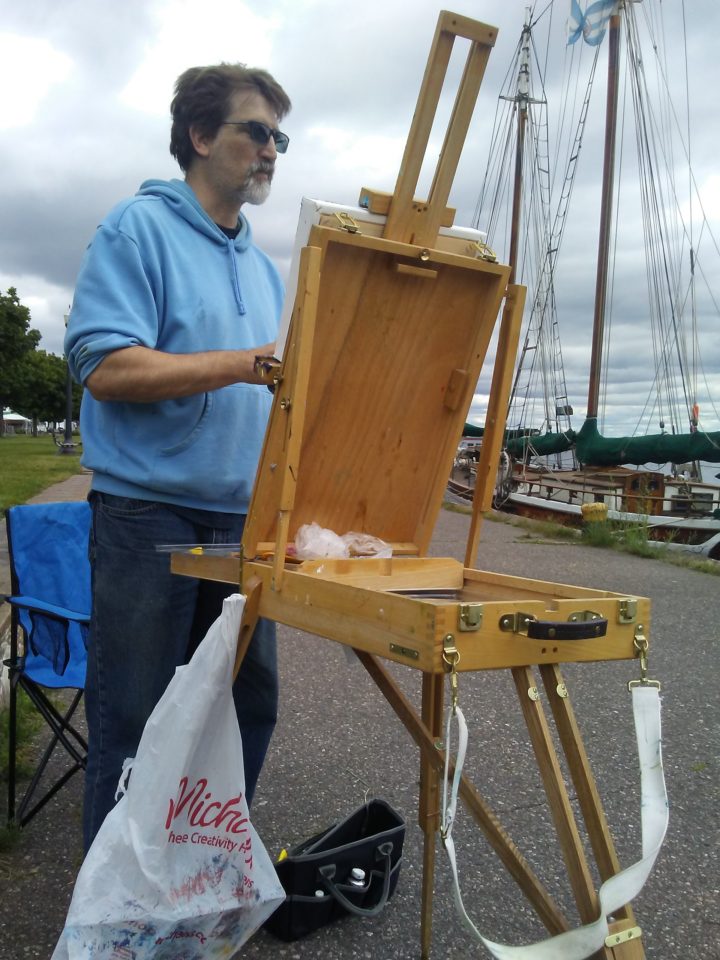
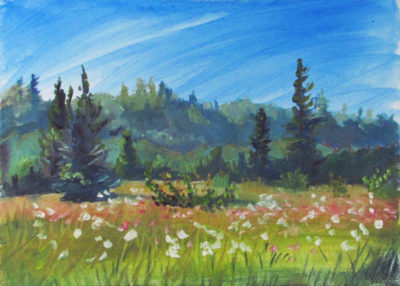
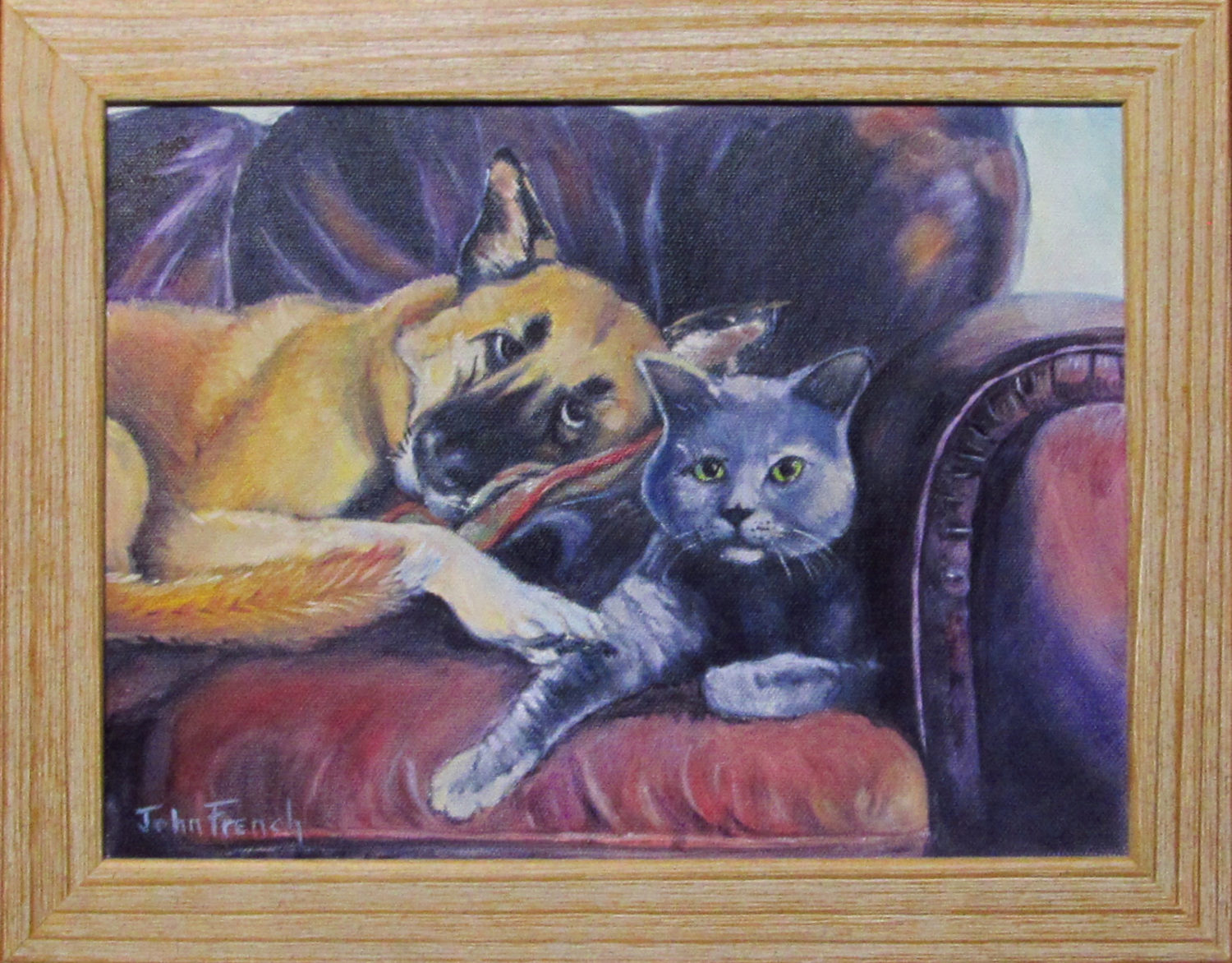
Marquette’s Art Week officially ended on Saturday. It was a week of artistic activity, including the Art Stroll in downtown Marquette, and culminating with the Fresh Coast Plein Air Festival and the reception that goes with it.
I took the week off from my real job so I could get ready for the events I had chosen to participate in. I got up early every morning and painted, working on new work to show off around town. I wanted to put out my best work to date. I wanted to be better than I was before, and I wanted to show the community that I was pursuing excellence.
Leading into Art Week, I was the featured artist on the cover of the Marquette Monthly. This lead to the sale of the row boat painting below! I man named Mike saw it on the cover, found me on Instagram, and said “That’s my boat!” He built it!
So I was up at 5:00 a.m. working on my paintings. I put out a few good paintings from my studio.
On Wednesday, I took a break from the studio and joined artists Kathleen Mooney and Kathleen Conover on a plein air session. Both are watercolorists, and both tend to paint a little on the abstract side. I was definitely the odd duck in this trio!
Kathleen Mooney takes a break to check on our paintings. Kathleen Conover energetically discussing the cedars and her painting process.The two Kathleens looking over Mooney’s work.Me, working on my painting.My wife takes prettynice photos, even of me! My painting at the end of the plein air session. I want to enhance it a bit in the studio before I put it out for sale.
Thursday was the Art Stroll! For me, the Art Stroll is the best part of Art Week! Downtown Marquette becomes a large outdoor art fair, as local artists team up with local businesses to show their work for the night.
In my case this year, I was one of the three featured artists at Madgoodies Studio. We got a lot of traffic, and even made the local news!
My painting “Lake Superior Tempest” dropped some jaws! More of my display at Madgoodies, including my latest at the time, “Little Presque Rocks”We even made the news!
Art shows are exhausting. On Friday I chilled a bit. In the evening, I went to register my canvas for the next day’s Plein Air Festival.
There was a sort of sub-event tied to the Plein Air Festival; the Dusk to Dark Plein Air event. Artists had to paint from between 6:00 p.m. and dark, and they had to stay in Presque Isle Park.
I made myself available to help with the registration, but they didn’t need me. So my wife and I wandered around and found the two Kathleens again, painting away at the setting sun!
The next morning, we got up early so I could paint my piece for the festival. I had scouted a great spot along a bubbling part of the Dead River. I don’t know why it’s called the Dead River. It’s teaming with life! The lush trees, the wildlife, the flowers and grasses… the bugs!
At first, I sat in the sand along the river. The mosquitoes started to buzz me, then bite me, then they even tried to carry me away. I had a natural bug deterrent that usually works well. That day, I could hear the mosquitoes laughing at me and my bug spray.
So I blocked in the scene, snapped a photo, and carried my stuff up the steep bank, into the sun and air, and finished it in relative comfort.
Down by the RiverThe scene when I started it.
Packing upThe finished piece.
The Plein Air Art Festival is billed as a competition. We compete. There were dozens of painters, and only a few could win.
I did not win a prize in the competition. But I don’t care. I’m proud of my painting. It’s probably the best plein air painting I’ve done. I’m happy with my effort and the way it turned out. It’s pretty!
Someone else agrees with me, and I got an even better prize. I sold the painting!
Art Week was a success for me. I had a lot of fun, I learned some things, I made new painting friends, I got my name out, I got my work out, I sold a few things.
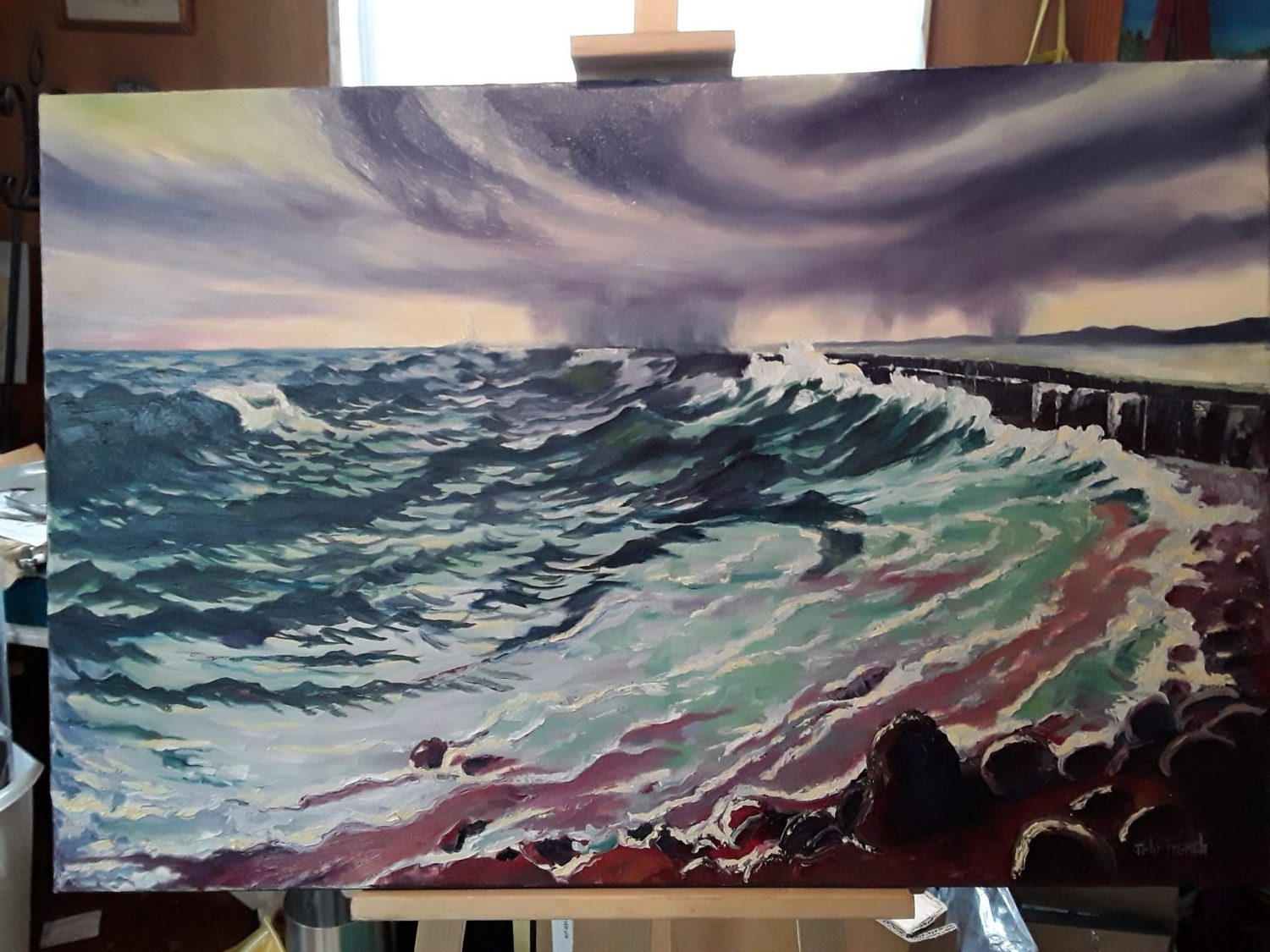
The large painting that I’m reworking is taking shape better than I had hoped. It now feels like a cold inland sea, whipped into a frenzy by an Autumn gale.
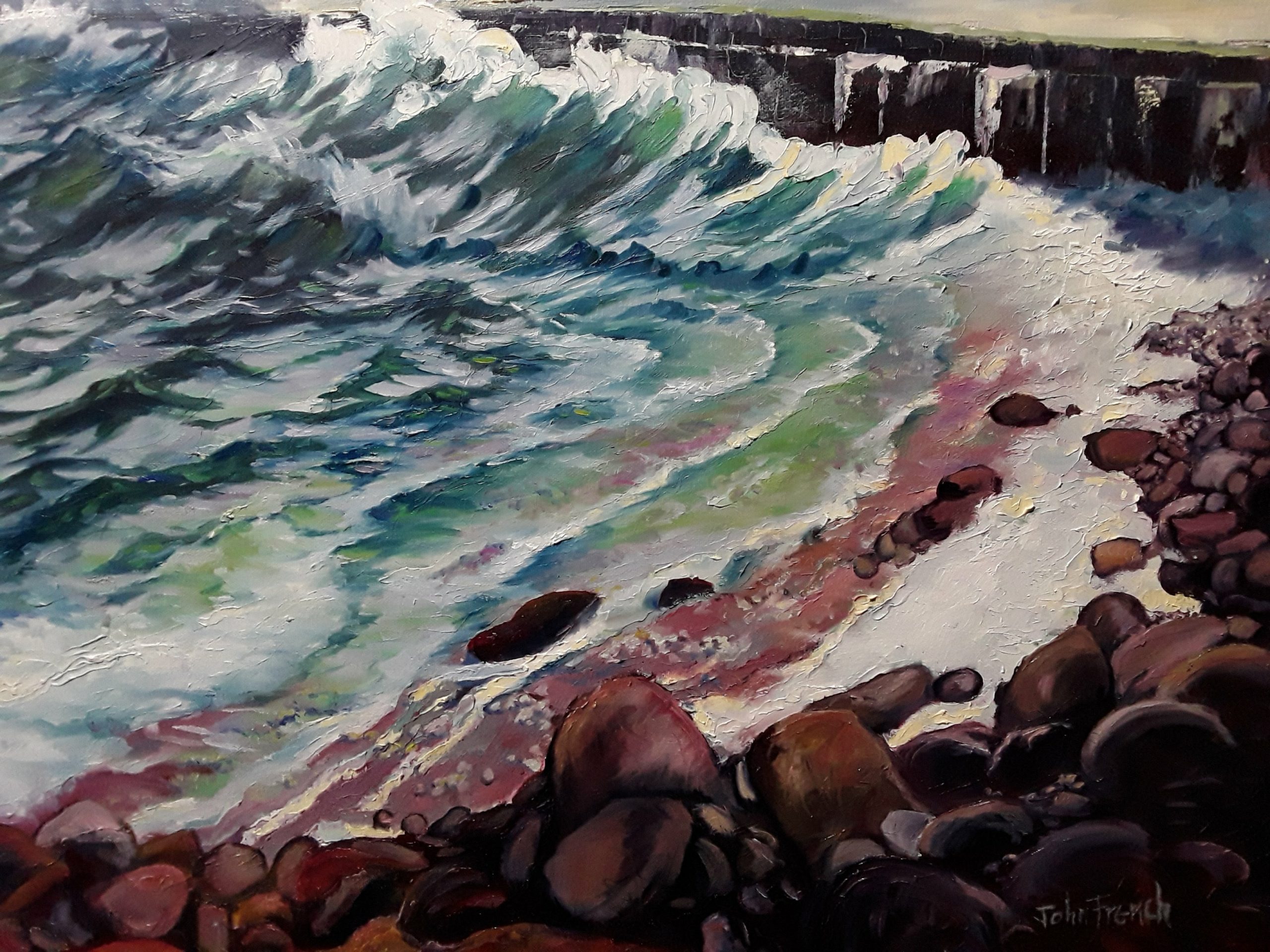
My next task is to work on the area in the foreground where the waves are breaking. At first, I thought I should paint the foamy places where the water breaks onto the rocky shore.
Quickly, I realized that I can’t convincingly paint these crashing waves without first defining the shoreline.
A few days before, I happened to be visiting this same spot on Lake Superior -without the storm, unfortunately- and took reference photos. Using the reference photos, as well as the knife strokes on the existing painting, I “sculpted” a rocky shorline.
Now that I have a well defined shore, I can start crashing some waves onto it!
Forgive me for taking so long to share my makeover progress. My youngest son just graduated from high school. The last several days have been busy, surreal, emotional, and exhausting!
I’ve been trying to pursue and achieve levels of personal and artistic excellence beyond the previous quality of my art. This means that I intend to craft paintings with a higher degree of professionalism and excellence than I’ve done before.
As I push myself, I notice some of my older paintings are kind of… well… not excellent.
In Part 1 of this short series, I told you that I was planning a rework, or makeover, of one of my older paintings. Although I like the composition and general feel of this large piece, it doesn’t meet my current standards of excellence. I want to show you how the makeover is progressing.
The painting was originally created with palette knives, so the paint is quite thick in some places. The first thing I needed to do was sand down the high points, so I would have a relatively smooth surface to paint on.
I used an electric sander to gently smooth out the surface. Then I wiped the entire surface with a rag soaked in mineral spirits and linseed oil.
On to the fun part: the actual act of painting! The first area I wanted to improve was the sky. The clouds in this painting were kind of dull. Though I did add dramatic swirls, they were flat, one color. Boring.
I darkened the clouds, starting from the top and worked my way in. Then I brightened the sky. I also streaked in some gorgeous reds along the horizon. Once I was happy with the tone and colors, I blended and softened the edges of the clouds, feathering the darks and lights together.
That looks much better already! I’m pretty happy so far.
Next, I took a long, in depth look at the water. It looks like the two waves, the one that is building up and the one that’s smashing into the break wall, are on two different planes. They don’t look like they’re in the same body of water. There’s a huge field of stretched water between them, and nothing to really tie them together.
In life, there can be a large stretching of water between waves, but there’s so much more to it than that. This water is churning, sloshing, moving back and forth. There’s constant movement as the water reacts to itself, creating smaller peaks and valleys of energy.
The area behind the waves was flat, not stormy. These two areas of the water don’t have any continuity. They don’t appear to depict the big lake at the same time.
To start with, I painted in small slashes and squiggles of dark, representing the large waves in the distance. Then, I built up the swelling wave so it’s taller, more dramatic. I added dark points and peaks, creating a rhythmic pattern of waves. These smaller rises and dips serve to connect the two waves in stormy, sloshing ebb and flow.
So far, I’m very happy with the progress of this painting. My next step is to carefully consider the foreground, and the way the water is interacting with the stone and concrete.
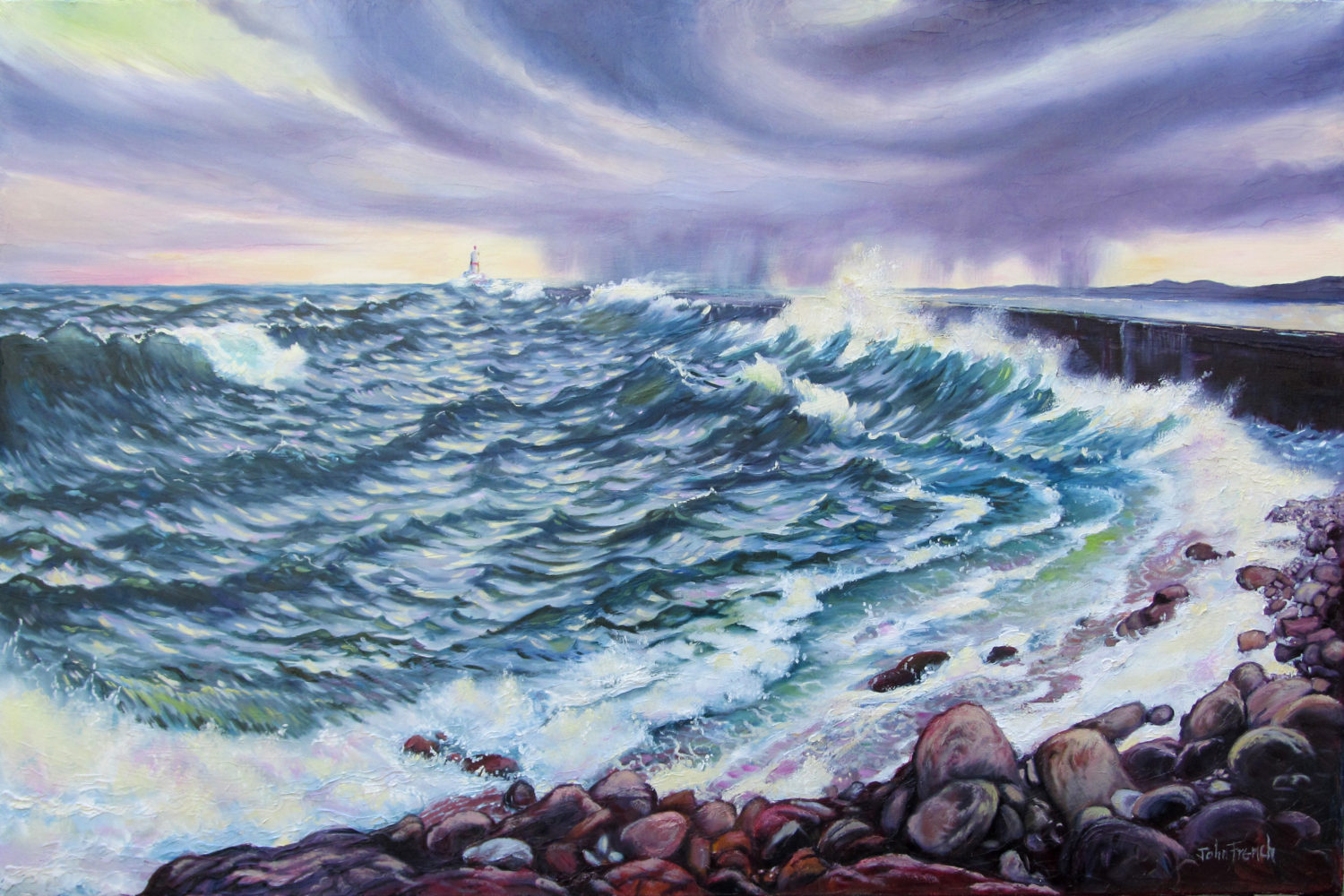
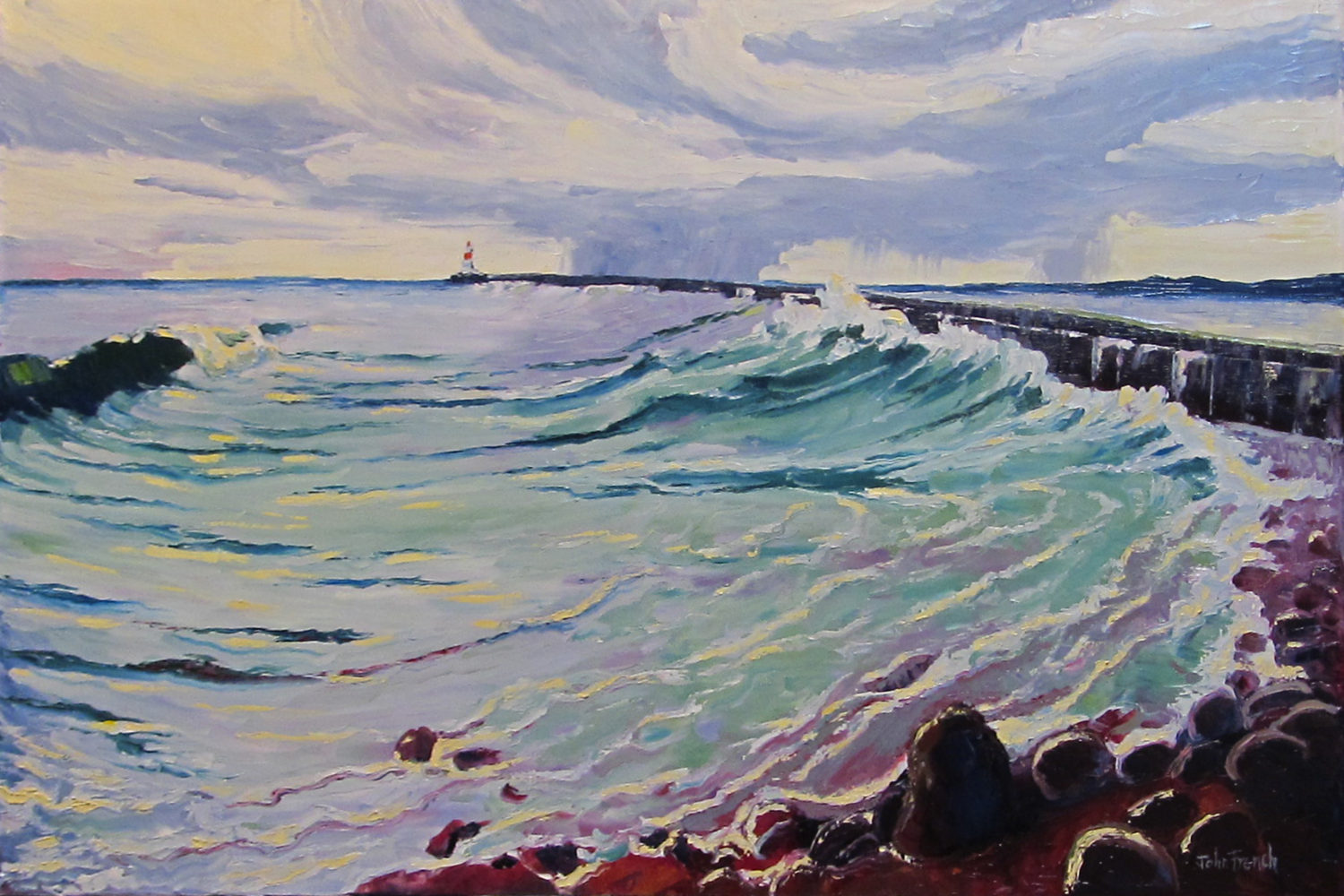
“Lake Superior Surging Against a Break Wall” 2016 Before the makeover
Such is the case with the painting on this page. I painted this scene in 2016, using a cell phone video as reference. It’s on a large canvas, 24″ X 36″, which is larger than I usually work. I painted it because I needed a ‘Wow Piece” for a show; something that would catch a person’s eye and drag them into my booth.
It worked. The simple light and dark colors worked together to create a sweeping and swirling composition that did, in fact, attract attention. I never expected it to sell, at least not right away. To my surprise, two people seemed interested in buying it, though they ultimately did not.
When the painting wasn’t on display, it was on my dining room wall, where I had to look at it day after day. Soon, my mistakes started becoming more and more obvious.
When I painted it, I worked almost exclusively with palette knives. The texture was great! The movement in the waves is awesome! But the perspective is off a bit. The middle, between the building wave and the crashing wave, is empty and boring. I probably worked too fast.
Over the last few years, I’ve look at this piece and told myself “I can do better.” Then, “I should’ve done better.”
Finally I told myself “I am going to make that better!”
You see, I have an Art Stroll event coming up in June. I need a Wow Piece. This is going to be it!
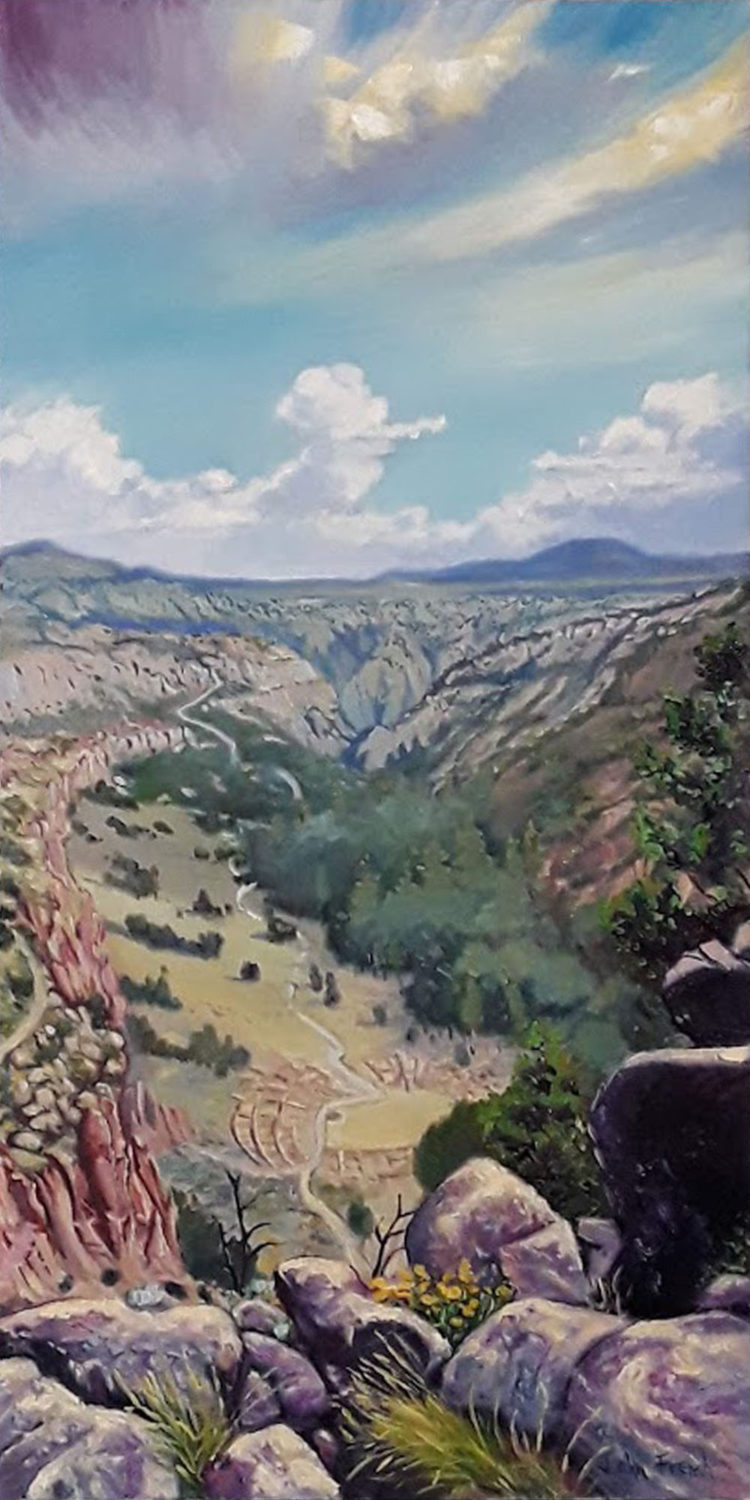
Let me tell you about this painting I recently finished. This dizzying view is looking down Frijoles Canyon onto Tyuonyi Pueblo, in Bandelier National Monument, New Mexico.
This is one of my favorite paintings that I’ve done recently. Every day, for almost 10 days, I couldn’t wait to sit down and lay some paint down.
What was it that got me so excited to work on this?
Well, for one, I love the area of the painting’s subject.
This is part of Bandelier National Monument, in New Mexico. This canyon cuts into the Pajarito Plateau, on the east slope of the Jemez Mountains, just west of Santa Fe.
The Jemez Mountains area is one of my favorite places to visit and paint. The beautiful green of Valles Caldera is flanked by rock mountains of orange, deep canyons, and shimmering steams. The Pajarito Plateau was formed by lava and ash from a prehistoric eruption of the Caldera.
In 2015, I hiked with my uncle over the plateau to the edge of the Frijoles Canyon. From there we could see some beautiful views! It was a great hike with a man I admire.
Bandelier is a 33000 acre area of wilderness and ruins. Trails run through the park, along the little stream, on the sides of cliffs, and over hills. The monument preserves the territory and some structures of a prehistoric Pueblo people.
The elliptical pattern at the bottom of the valley is the ruins of the Tyuonyi Pueblo. Each box-shape would have been a room, entered from the top. Other rooms were built on top to form a multi storied building, housing many families.
Each room was entered from the top with a ladder. The arrangement of “apartments” formed a circular structure, with only one entrance. These puebloans would have been well protected.
The larger hole in the ground is one of three kivas. Kivas were underground rooms used for religious, social, and political purposes.
These prehistoric pueblo people settled here around 1200, and built this particular structure around 1400. This date is well established through tree ring dating of the roof beams.
By the time the Spanish arrived in the 1500’s, Frijoles Canyon had been abandoned because of severe drought, and its people migrating to the Rio Grande valley.
I love history and archaeology, so I was really into this piece. I was also pumped about the composition and depth. I love painting the difference between far and near!
I thought about this scene for a long time. The view was so breathtaking, I didn’t think I could do it any justice. The landscape stretched out so far!
I decided to tackle it, so I bought a tall, narrow canvas. The shape of the canvas, I thought, would let me capture the depth of the canyon, and the distance of the plateau and neighboring mountains, while keeping the sides narrow, like a canyon wall.
Once I started, I was obsessed! I couldn’t wait to get in the studio and develop this piece.
This is the photo I chose to paint from. I love how the road and trail stretch way back in the scene. The first thing I did was sketch out the scene with dark paint. Then I painted in the sky with three different blues!I added some billowing clouds in the distance, then started working my way forward. I was careful to keep the shadows blue, and the highlights on the gray side. This helps “push back” the scene.As I got close to the viewing plane, I gradually added more color. Here, the cliffs and valley floor are blocked in, ready for highlights and detailing.Finally, after forming cliffs and rocks, and adding some trees, the road, and other mid-ground details, I was ready to paint the foreground rocks. I wanted the foreground to pop, so I used lots of bold darks and some bright colors.
And there you go! Now you know all about the making of this painting, “Above Frijoles Canyon”
You may remember I mentioned that the Jemez Mountains was my favorite place to paint. Below are a few other paintings of mine from the area. The last one is the same canyon, from almost the same place, but looking in the opposite direction!
Valles Caldera ~an ancient, extinct super volcano. This view is from the rim of the caldera looking acros the crater. Picnic with Giants ~a fry-bread taco stand in Jemez Springs Looking Down Frijoles Canyon Towards the Caldera
The Lake Superior Art Association (LSAA) usually holds their Annual Members’ Show in the summer. We all know this around here. This year, the venue was being renovated during the summer, so the show was postponed until January.
In all the confusion, I thought I had missed it. I checked the LSAA site, and saw that I’d missed the pre-registration deadline. So I decided not to be a rule breaker, and to not enter.
The LSAA President, and my friend, Michele Tuccini, encouraged me to enter anyway. They were being extra flexible because of the construction delays. So I changed my mind, and entered.
We could enter two pieces, but only one would be chosen. So the jurors chose one of my personal favorites, “The View”.
The View
The reception and awards ceremony were last night, January 19th. My wife and I showed up right on time and began to mingle.
I said hello to one of my friends, Nheena. She’s the director of the Upper Peninsula Children’s Museum, and a well loved member of the community.
Nheena said “Congratulations!”
I said “For what?”
“Didn’t you do good with your painting?”
“Yeah… I got in. Thanks!”
Nheena is always super friendly. I walked away thinking she was just being her usual peppy, sweet self.
So we mingled and chatted until award time.
They started announcing the awards. Honorable Mention #1 was a great piece, not mine. Honorable Mention #2, another great piece, not mine.
2nd Place went to a large piece by Bernard Park. Great painting!
1st Place went to local freaking legend Kathleen Conover. She’s great! Who can beat her?
So I didn’t win.
But wait, there’s more… I forgot about Best in Show.
Michele made the announcement, in slow motion, while I looked around the room trying to guess which piece won.
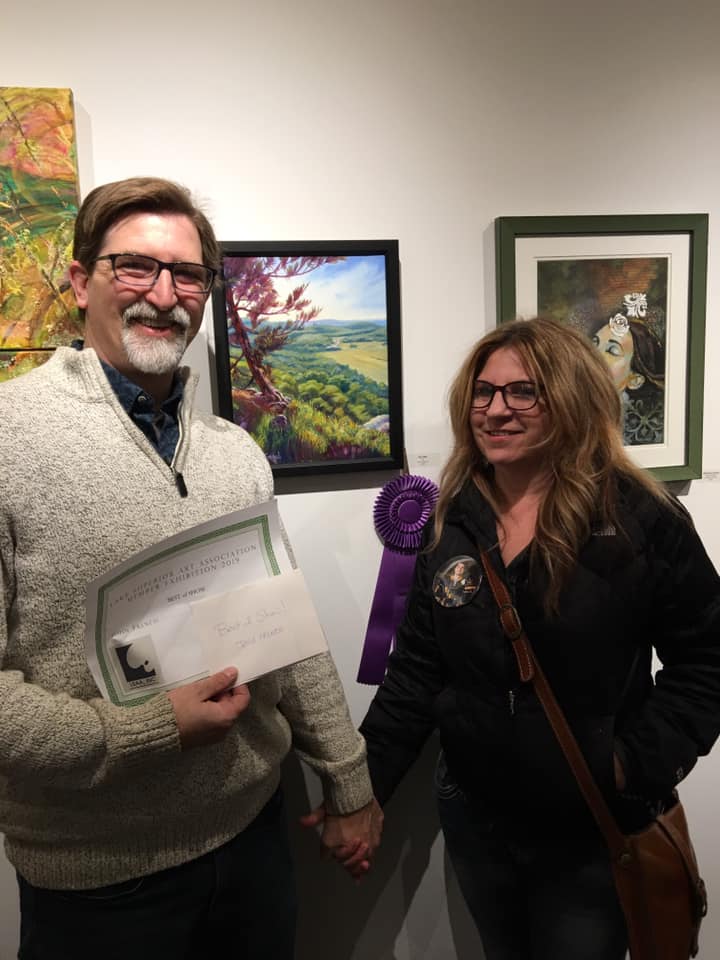
“Best in Show goes to the painting entitled ‘The View’…” (Hey, that’s my title!) “…by John French”
What? The words processed slowly through my little brain. Once they did, I was shocked! I was honored! I was in disbelief! My wife was too. People congratulated me, and talked about the painting. I thanked them, and answered their questions, beaming the whole time.
Back to Nheena. I found out she was one of the jurors. When she congratulated me, she thought I knew I’d won. She almost spilled the beans! She quickly figured out that the winners hadn’t been disclosed yet, so she played dumb.
I am honored, and thankful, for this wonderful recognition. There was some absolutely fantastic work in this show. I’ve juried this same show before, and I know how hard it can be to chose award winners. I can still hardly believe that I beat out all that wonderful work.
I’ve been thinking about plein air painting. It’s winter, and that means bitter cold. I’m longing for warm days, bright sunshine, and green hills. I want to get outside and paint!
Besides the rewards of painting from nature, I’ve been pondering the difficulties and challenges that naturally occur when you’re set up outside.
I wanted to share a little insight into this art form. I hope that by the time you get to the end of this article, you have a new appreciation for plein air paintings, and the artists who produce them.
Quick History
Renoir’s “Monet Painting in His Garden at Argenteuil”
“En plein air” is the proper term referring to “painting outside”. The term goes back to the French impressionist period, although the practice goes back much further. Artists have long made sketches and studies in nature, then refined those loose paintings into polished studio works.
According to the book Monet by Frank Milner, Claude Monet “insisted that all of the picture should be painted from start to finish with the subject before him.” This included landscapes. Since light is fleeting, the painting had to be worked quickly and with loose, expressive strokes. Each paint mark had to mean something.
By the way, Monet painted outside throughout the year, even in the winter. He wasn’t deterred by cold and snow like I am. Of course, he painted in France. I paint in Upper Michigan.
Getting out There
Around the time of the impressionists, the French easel was introduced. This paint box enabled an artist to have a compact, mobile studio. The French easel has folding and telescoping legs, a small drawer for paints and tools, and of course an adjustable easel. The whole thing folds up to the size of a small suitcase, complete with a handle and a shoulder strap.
Two artists, with their French easels, painting at Gooseberry Falls in Minnesota.
The French easel allows the artist to paint comfortably whether he wishes to stand or sit. The canvas is securely clamped and the whole thing is pretty sturdy. When the painting session is finished, the easel can be folded up, keeping the wet painting safely clamped for the journey back to the studio.
As compact and handy as it is, a French easel can still be heavy and cumbersome for some artists, especially if you’re going on a long hike to a painting locale.
The Landscape at Hand
Once the artist is set up at the chosen location, he is faced with a busy and overwhelming scene before him. There is the task of translating a huge world into a small painting. One must decide what to keep, and what to omit. We simply can’t paint everything.
An artist at Porcupine Mountain State Park in Michigan
There are a million tree branches, leaves, twigs, stones, and blades of grass. The scene must be simplified, or the resulting painting will be busy, hectic and quite possibly an incohesive mess. In addition, it will be impossible to complete in a single session.
The artist has to fit the elements of the scene into the boundaries of the canvas. A lighthouse in the east may not fit with the cliff to the west. Many artists use “view finders”, small, open frames that can be used to visually compose the scene.
A distant hill may need to be more blue or gray than it appears in life, in order to give the painting the feeling of depth in the actual scene. A tree may need to be omitted or moved because it blocks the flow of the composition.
So you must be wondering, what is the point of plein air painting if the artist has to adjust the scene? For me, it’s observing the colors, and learning how the light and atmosphere interact. Painting outside creates an intimacy with the landscape. These observations cannot be adequately made or expressed through a photo. A good plein air artist will be able to present a well painted and well composed piece with a natural feel.
Weather
As with any outdoor activity, whether you’re planning a family cook-out, or just taking a walk, you must always consider the weather when planning a plein air outing.
I’ve had paintings topple over in sudden gusts of wind. I’ve been hot, I’ve been cold. I’ve been rained on. Once I sat on the rocks near a rough Lake Superior, painting the waves while the spray soaked me.
A watercolorist friend of mine painted a church en plein air. Then it rained on him. The result was a neat abstraction; a partnership between the artist and the elements.
Bugs
Bugs love my work. They love to fly into it. Sometimes I can pick them out and send them on their way, their legs a bit more colorful. Often, they are coated with paint and can’t fly. Sometimes, I can’t pick them out, and they become part of the painting.
Of course, sometimes the bugs bother me, too. I try to dress for it. I don’t like to use bug spray, so I wear long pants, and a light long sleeved shirt. They still like to swarm my face and get in my ears and hair.
I painted the scene below while black flies were chewing up my ankles. I was dancing while I worked, and swatting between brush strokes.
Lake Superior Plein Air
I’ve found that eating a good diet and avoiding sweets seems to keep the bugs away. I try not to make myself very tasty.
Passers-by
Plein air painter from Ohio in Michigan’s Porcupine Mountains. I wish I’d caught her name. She was good.
Some people really like to see an artist at work outside! I enjoy this part. I like when people stop and watch. I can interact with these folks, and perhaps sell to them. It’s a great way to promote my art!
I didn’t like dealing with passers-by when I first started plein air painting. I wasn’t confident in my work. I struggled with the beginning stages, and would ask people to come back later, when the painting would hopefully look better.
At first, I chose out of the way places where nobody would bother me. Then I started going to quiet parks, or popular trails. Then to busier places.
People stop, and watch. I greet them, letting them know they’re welcome to stick around. We talk. They ask questions. They move on. People don’t bother me.
I know other artists who just want to paint, and not be bothered. I saw two painters in Michigan’s Porcupine Mountains. One painter was super friendly and chatty. The other was in her zone, and not the friendliest. I understood, and I left her alone.
Time
The day can move fast, especially when you’re spending a couple of hours trying to capture a fleeting moment. Light changes quickly. If the artist doesn’t work fast enough, one part of the painting will depict the morning, and another part will depict the afternoon.
A small painting of a fleeting evening
Atmospheric conditions can change too. Clouds clear up. Fog rolls in. Fog rolls out. So many times the sky will change, showing you better light than you had when you started. Or it will cloud over, removing light from a spot you were just working on.
I painted the piece at left en plein air in 2017. When I started, it was cloudy. As I worked, the clouds broke open and the sun blazed out. It left sparkles in the water and highlights on the rocks. I had to work fast to get those new illuminations into the painting!
I usually block-in the scene in dark paint, paying attention to the placement of elements and their relationships. I then start building the lights. I might save the sky for last, depending on the cloud formations and conditions.
In this painting, I was focused on capturing the rippled reflections in the water and the deep greens within.
Appreciation for Plein Air Paintings
My hope is that you, the art observer, the art lover, and the art collector, will have a greater appreciation for the art of plein air. The paintings are often small, loose, rough little expressions of raw experience. A plein air artist is dedicated to his or her craft of painting realistic, authentic, and expressive landscape paintings.
Let’s talk about small paintings. I mean around 5″ x 7″. Just a little bit bigger than a postcard.
First, I’ll tell you why I like to make them. Then we’ll see why you might like to have one or two.
Experimentation
Sometimes I have an idea for a different style or a new technique. I’ll try my idea on one of these small canvases to see how it works.
For example, the painting at right, entitled “Moon Quarry”. Large chunks of granite had been quarried from this hillside, leaving a jagged cliff face, adorned with a sweeping stand of hardwoods.
I’ve been a palette knife painter since 2012. I was ready to try something different: a brush.
When I look into a shadow on a hill, or a rock face, or a forest floor, or whatever, I notice the way the reflective light creates subtle colors within the shadow.
So I made rich, deep, translucent colored shadows. I used the shadows to sculpt the shape of the hills, the sweep of the landscape, and the steep angle of the cliffs.
Then I took up a familiar tool, my painting knife, and illuminated the scene with bold spots of fall color and jagged rock faces.
Another experiment was the painting below called “Jemez Rock Abstract”
This was inspired by a red rock mountain in the Jemez Mountains in New Mexico. The setting sun cast cool zigzag shadows over the side of the rock. I thought it looked like lightning. I simplified the scene, and put some electric blue in the shadow, as if the sky itself was traveling down the mountain.
In this painting of the Mackinac bridge, I was simple playing with new colors, and trying out a brighter sky.
Look at that glowing orange sky!
Plein Air, chasing the elusive light, another reason to use a small canvas
When I paint outside, I want to capture a scene quickly. I want to record the fleeting light without being sloppy.
So I use small canvases.
These little guys are often sketches for bigger paintings, like the pieces below: “Late Summer, Michigan”, on the left, was a plein air piece that inspired “Passing Summer Storm” on the right.
On Hold
The painting to the right was mostly painted on the Lake Superior shoreline, but finished in the studio. I wanted to get the rocks just right, but it got cold!
Although I call them ‘sketches’, these little plein air paintings can stand up for themselves! They are finished pieces all their own.
Why Would You Want One?
There are lots of reasons that a collector might want one of these.
If you’re new to collecting art, like I am, you may want to start small. This past year my wife and I bought several pieces of art, most of them were small!
Small paintings are budget friendly, and they’re also small-space friendly. I recently finished a commission of three little paintings. My client in this case wanted an art piece that would fit on her desk, and two others that she could gift to a family member and a friend. She’ll get three original paintings for a very good price.
So if you’re new to the art world, or if you don’t have much wall space, or if you don’t want it on a wall, or if you’re watching a budget, these little paintings are right for you!
Treat yourself!
Check out the selection of small paintings that I have available here!
Click Here
We use cookies on our website to give you the most relevant experience by remembering your preferences and repeat visits. By clicking “Accept”, you consent to the use of ALL the cookies.
This website uses cookies to improve your experience while you navigate through the website. Out of these, the cookies that are categorized as necessary are stored on your browser as they are essential for the working of basic functionalities of the website. We also use third-party cookies that help us analyze and understand how you use this website. These cookies will be stored in your browser only with your consent. You also have the option to opt-out of these cookies. But opting out of some of these cookies may affect your browsing experience.
Necessary cookies are absolutely essential for the website to function properly. These cookies ensure basic functionalities and security features of the website, anonymously.
Cookie
Duration
Description
cookielawinfo-checkbox-analytics
11 months
This cookie is set by GDPR Cookie Consent plugin. The cookie is used to store the user consent for the cookies in the category "Analytics".
cookielawinfo-checkbox-functional
11 months
The cookie is set by GDPR cookie consent to record the user consent for the cookies in the category "Functional".
cookielawinfo-checkbox-necessary
11 months
This cookie is set by GDPR Cookie Consent plugin. The cookies is used to store the user consent for the cookies in the category "Necessary".
cookielawinfo-checkbox-others
11 months
This cookie is set by GDPR Cookie Consent plugin. The cookie is used to store the user consent for the cookies in the category "Other.
cookielawinfo-checkbox-performance
11 months
This cookie is set by GDPR Cookie Consent plugin. The cookie is used to store the user consent for the cookies in the category "Performance".
viewed_cookie_policy
11 months
The cookie is set by the GDPR Cookie Consent plugin and is used to store whether or not user has consented to the use of cookies. It does not store any personal data.
Functional cookies help to perform certain functionalities like sharing the content of the website on social media platforms, collect feedbacks, and other third-party features.
Performance cookies are used to understand and analyze the key performance indexes of the website which helps in delivering a better user experience for the visitors.
Analytical cookies are used to understand how visitors interact with the website. These cookies help provide information on metrics the number of visitors, bounce rate, traffic source, etc.
Advertisement cookies are used to provide visitors with relevant ads and marketing campaigns. These cookies track visitors across websites and collect information to provide customized ads.