The Lake Superior Art Association (LSAA) usually holds their Annual Members’ Show in the summer. We all know this around here. This year, the venue was being renovated during the summer, so the show was postponed until January.
In all the confusion, I thought I had missed it. I checked the LSAA site, and saw that I’d missed the pre-registration deadline. So I decided not to be a rule breaker, and to not enter.
The LSAA President, and my friend, Michele Tuccini, encouraged me to enter anyway. They were being extra flexible because of the construction delays. So I changed my mind, and entered.
We could enter two pieces, but only one would be chosen. So the jurors chose one of my personal favorites, “The View”.
The View
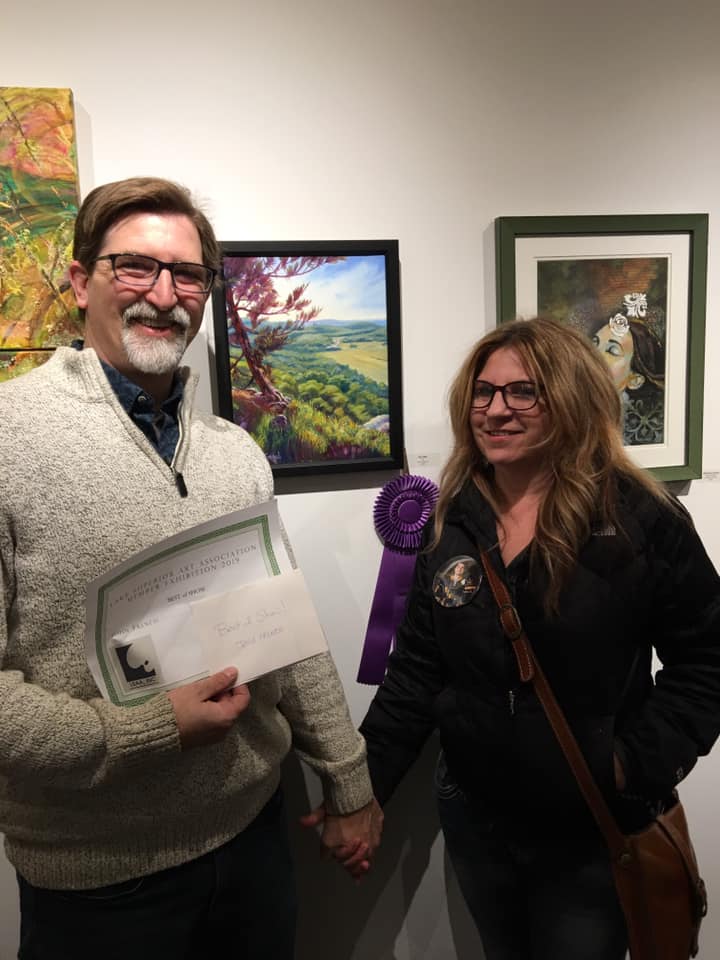
The reception and awards ceremony were last night, January 19th. My wife and I showed up right on time and began to mingle.
I said hello to one of my friends, Nheena. She’s the director of the Upper Peninsula Children’s Museum, and a well loved member of the community.
Nheena said “Congratulations!”
I said “For what?”
“Didn’t you do good with your painting?”
“Yeah… I got in. Thanks!”
Nheena is always super friendly. I walked away thinking she was just being her usual peppy, sweet self.
So we mingled and chatted until award time.
They started announcing the awards. Honorable Mention #1 was a great piece, not mine. Honorable Mention #2, another great piece, not mine.
2nd Place went to a large piece by Bernard Park. Great painting!
1st Place went to local freaking legend Kathleen Conover. She’s great! Who can beat her?
So I didn’t win.
But wait, there’s more… I forgot about Best in Show.
Michele made the announcement, in slow motion, while I looked around the room trying to guess which piece won.
“Best in Show goes to the painting entitled ‘The View’…” (Hey, that’s my title!) “…by John French”
What? The words processed slowly through my little brain. Once they did, I was shocked! I was honored! I was in disbelief! My wife was too. People congratulated me, and talked about the painting. I thanked them, and answered their questions, beaming the whole time.
Back to Nheena. I found out she was one of the jurors. When she congratulated me, she thought I knew I’d won. She almost spilled the beans! She quickly figured out that the winners hadn’t been disclosed yet, so she played dumb.
I am honored, and thankful, for this wonderful recognition. There was some absolutely fantastic work in this show. I’ve juried this same show before, and I know how hard it can be to chose award winners. I can still hardly believe that I beat out all that wonderful work.
I’ve been thinking about plein air painting. It’s winter, and that means bitter cold. I’m longing for warm days, bright sunshine, and green hills. I want to get outside and paint!
Besides the rewards of painting from nature, I’ve been pondering the difficulties and challenges that naturally occur when you’re set up outside.
I wanted to share a little insight into this art form. I hope that by the time you get to the end of this article, you have a new appreciation for plein air paintings, and the artists who produce them.
Quick History
Renoir’s “Monet Painting in His Garden at Argenteuil”
“En plein air” is the proper term referring to “painting outside”. The term goes back to the French impressionist period, although the practice goes back much further. Artists have long made sketches and studies in nature, then refined those loose paintings into polished studio works.
According to the book Monet by Frank Milner, Claude Monet “insisted that all of the picture should be painted from start to finish with the subject before him.” This included landscapes. Since light is fleeting, the painting had to be worked quickly and with loose, expressive strokes. Each paint mark had to mean something.
By the way, Monet painted outside throughout the year, even in the winter. He wasn’t deterred by cold and snow like I am. Of course, he painted in France. I paint in Upper Michigan.
Getting out There
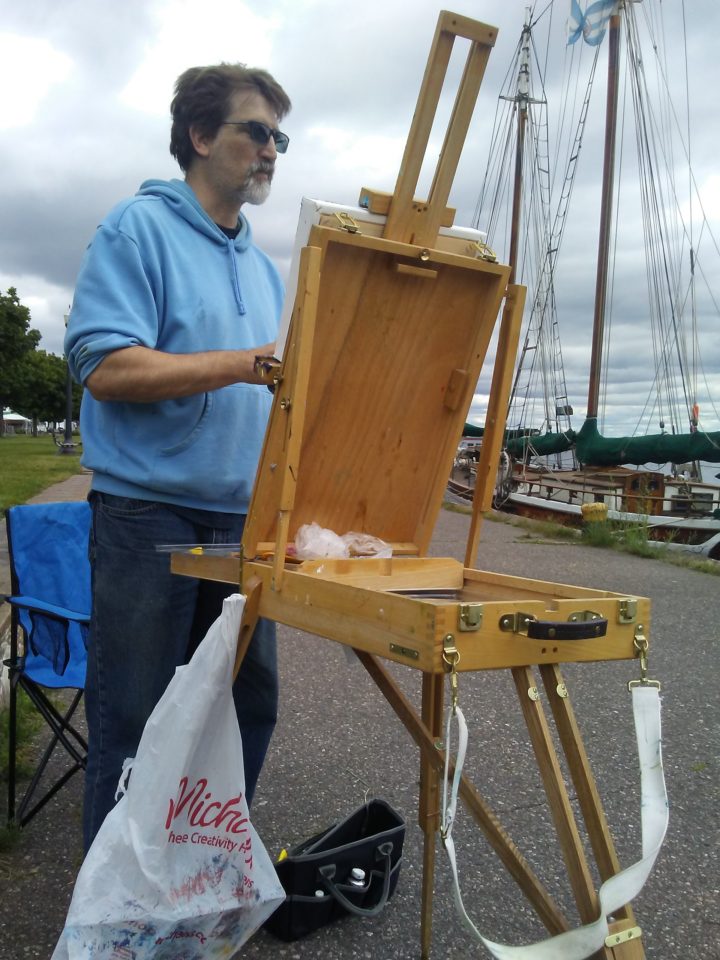
Around the time of the impressionists, the French easel was introduced. This paint box enabled an artist to have a compact, mobile studio. The French easel has folding and telescoping legs, a small drawer for paints and tools, and of course an adjustable easel. The whole thing folds up to the size of a small suitcase, complete with a handle and a shoulder strap.
Two artists, with their French easels, painting at Gooseberry Falls in Minnesota.
The French easel allows the artist to paint comfortably whether he wishes to stand or sit. The canvas is securely clamped and the whole thing is pretty sturdy. When the painting session is finished, the easel can be folded up, keeping the wet painting safely clamped for the journey back to the studio.
As compact and handy as it is, a French easel can still be heavy and cumbersome for some artists, especially if you’re going on a long hike to a painting locale.
The Landscape at Hand
Once the artist is set up at the chosen location, he is faced with a busy and overwhelming scene before him. There is the task of translating a huge world into a small painting. One must decide what to keep, and what to omit. We simply can’t paint everything.
An artist at Porcupine Mountain State Park in Michigan
There are a million tree branches, leaves, twigs, stones, and blades of grass. The scene must be simplified, or the resulting painting will be busy, hectic and quite possibly an incohesive mess. In addition, it will be impossible to complete in a single session.
The artist has to fit the elements of the scene into the boundaries of the canvas. A lighthouse in the east may not fit with the cliff to the west. Many artists use “view finders”, small, open frames that can be used to visually compose the scene.
A distant hill may need to be more blue or gray than it appears in life, in order to give the painting the feeling of depth in the actual scene. A tree may need to be omitted or moved because it blocks the flow of the composition.
So you must be wondering, what is the point of plein air painting if the artist has to adjust the scene? For me, it’s observing the colors, and learning how the light and atmosphere interact. Painting outside creates an intimacy with the landscape. These observations cannot be adequately made or expressed through a photo. A good plein air artist will be able to present a well painted and well composed piece with a natural feel.
Weather
As with any outdoor activity, whether you’re planning a family cook-out, or just taking a walk, you must always consider the weather when planning a plein air outing.
I’ve had paintings topple over in sudden gusts of wind. I’ve been hot, I’ve been cold. I’ve been rained on. Once I sat on the rocks near a rough Lake Superior, painting the waves while the spray soaked me.
A watercolorist friend of mine painted a church en plein air. Then it rained on him. The result was a neat abstraction; a partnership between the artist and the elements.
Bugs
Bugs love my work. They love to fly into it. Sometimes I can pick them out and send them on their way, their legs a bit more colorful. Often, they are coated with paint and can’t fly. Sometimes, I can’t pick them out, and they become part of the painting.
Of course, sometimes the bugs bother me, too. I try to dress for it. I don’t like to use bug spray, so I wear long pants, and a light long sleeved shirt. They still like to swarm my face and get in my ears and hair.
I painted the scene below while black flies were chewing up my ankles. I was dancing while I worked, and swatting between brush strokes.
Lake Superior Plein Air
I’ve found that eating a good diet and avoiding sweets seems to keep the bugs away. I try not to make myself very tasty.
Passers-by
Plein air painter from Ohio in Michigan’s Porcupine Mountains. I wish I’d caught her name. She was good.
Some people really like to see an artist at work outside! I enjoy this part. I like when people stop and watch. I can interact with these folks, and perhaps sell to them. It’s a great way to promote my art!
I didn’t like dealing with passers-by when I first started plein air painting. I wasn’t confident in my work. I struggled with the beginning stages, and would ask people to come back later, when the painting would hopefully look better.
At first, I chose out of the way places where nobody would bother me. Then I started going to quiet parks, or popular trails. Then to busier places.
People stop, and watch. I greet them, letting them know they’re welcome to stick around. We talk. They ask questions. They move on. People don’t bother me.
I know other artists who just want to paint, and not be bothered. I saw two painters in Michigan’s Porcupine Mountains. One painter was super friendly and chatty. The other was in her zone, and not the friendliest. I understood, and I left her alone.
Time
The day can move fast, especially when you’re spending a couple of hours trying to capture a fleeting moment. Light changes quickly. If the artist doesn’t work fast enough, one part of the painting will depict the morning, and another part will depict the afternoon.
A small painting of a fleeting evening
Atmospheric conditions can change too. Clouds clear up. Fog rolls in. Fog rolls out. So many times the sky will change, showing you better light than you had when you started. Or it will cloud over, removing light from a spot you were just working on.
I painted the piece at left en plein air in 2017. When I started, it was cloudy. As I worked, the clouds broke open and the sun blazed out. It left sparkles in the water and highlights on the rocks. I had to work fast to get those new illuminations into the painting!
I usually block-in the scene in dark paint, paying attention to the placement of elements and their relationships. I then start building the lights. I might save the sky for last, depending on the cloud formations and conditions.
In this painting, I was focused on capturing the rippled reflections in the water and the deep greens within.
Appreciation for Plein Air Paintings
My hope is that you, the art observer, the art lover, and the art collector, will have a greater appreciation for the art of plein air. The paintings are often small, loose, rough little expressions of raw experience. A plein air artist is dedicated to his or her craft of painting realistic, authentic, and expressive landscape paintings.
I want to tell you about one of my favorite recent paintings. The inspiration for this handsome piece came from a gorgeous little town in Wisconsin.
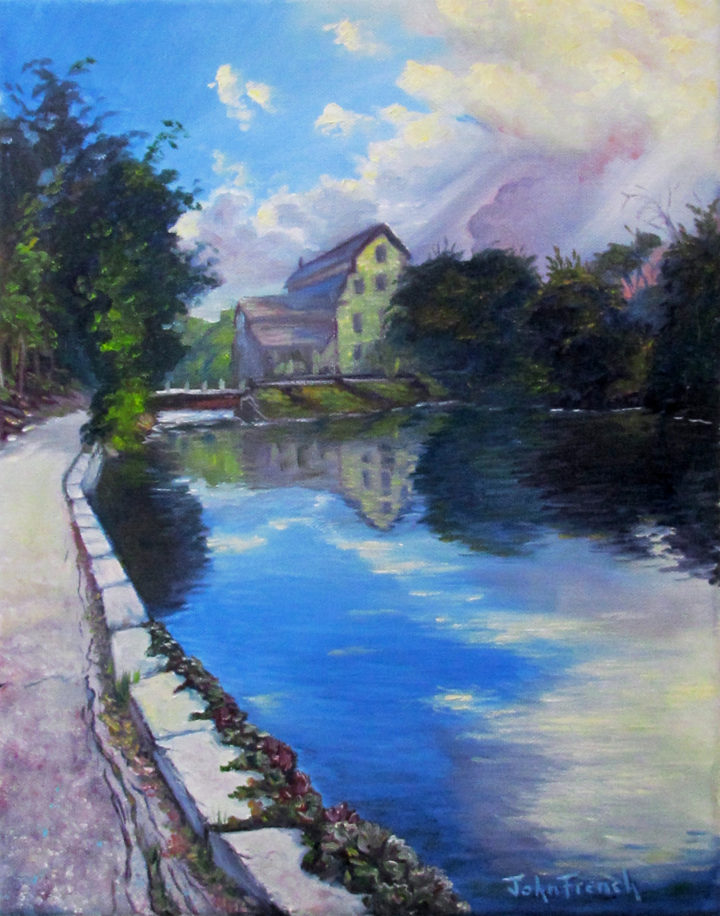
“Because of the River”
This is a painting of a large, historic gristmill in the city of Cedarburg, WI.
A few years ago, my wife and I were on our way to Milwaukee to pick my son up from the airport. He was flying in from Rehoboth Beach, DE, and Milwaukee had good deals on flights.
Anyway, we decided to take a detour through Cedarburg. I had seen it on a Google Maps, and thought it looked like a nice place to visit.
I was right! What a neat town! We were charmed by the architecture, the shops, the art, and the activity. The streets were bustling with people.
Cedarburg was settled in the 1840’s. A wooden gristmill was built in 1844 on Cedar Creek. In the 1850’s, this structure was replaced by the impressive, five-story, stone gristmill that stands today. The stone building and the creek are the subject of this painting.
Cedarburg is now a destination for tourists. It seems that every weekend there is some sort of festival or event.
Best of all, there’s a great arts scene in Cedarburg. The mills have become shops, studios and art galleries.
There are also galleries throughout the town’s historic buildings, along with specialty food shops, antique stores, cafes, and restaurants.
Cedar Creek, to be more specific. Hence the title.
Own it today!
[simpay id=”984″]
Look at the river walk. You can see the pebbles in the asphalt. You can see how the ground has shifted, maybe washed away, causing the surface of the walk to crack and sag a little. The path disappears in a tunnel of trees, leading you to a bridge across the creek. The imposing stone building glows in the diffused Wisconsin light. The road leads to something behind the massive trees. Approaching storm clouds billow and swirl in the background as rays of sunlight manage to get through. The serenity of the scene is reflected in the broken ripples of the gently flowing Cedar Creek.
The painting is composed on an 11X14 canvas. The price is $250.00, unframed.
[simpay id=”984″]
For a small amount more, I can frame it for you. For more about that, visit my online gallery entry here.
By the way, this isn’t the first time I’ve painted the gristmill in Cedarburg. My friend Brian M. bought this painting from me last year.
My two paintings “Looking Down Frijoles Canyon Towards the Caldera” and “Will that Rain Come Over Here?” have made it to the walls of the Manzano Mountain Arts Council 23 Years of Enchantment show.
I had shipped the paintings through the United States Postal Service, just making the due date of August 16.
Normally, I get very good service from the Post Office.
This time, there was a careless, idiotic mix-up at the Mountainair Post Office, and my work was shipped back to me because of “Insufficient Address”. Probably because I accidentally put the street address rather than the P.O. Box.
OK, my bad.
Mountainair is a very small town. Apparently, they couldn’t -or wouldn’t- figure out where the package was supposed to go, even though there’s only one Arts Center in town, and it happens to be less than two blocks away.
They could spit on each other, even on a windy day!
So I had to ship them back, two-day guaranteed.
They made it, and the VP of the Board, John Stange, was great enough to hang them the day before the event.
Thanks, John! The folks in Mountainair sure are nice people!
The Jemez are a group of volcanic mountains west of Santa Fe, NM. At the center of the mountians is the beautiful Valles Caldera, a long extinct super volcano.
Entering the mountains from the south treats you to stunning views of red rock mountains and cliffs.
Valles Caldera Painting
John Nieto
Santa Fe artist John Nieto (https://www.nietofineart.com/ was known for painting people and animals in bright and vivid colors, strong lines, and straightforward composition.
Mr. Nieto passed away in July of 2018 at the age of 81.
My wife and I saw Mr Nieto’s work at Ventana Gallery in Santa Fe in 2015. I’m thankful that I was able to see his work.
I won’t post photos of his work out of respect to the artist and his estate. Please follow the link above to see his work.
Let’s Paint New Mexico (LPNM) Group
A few years ago, Albuquerque artist Dee Sanchez (http://deesanchez.com/) started the “Let’s paint New Mexico” blog, to which she would post a photo of a New Mexico scene. It could be a landscape, a still life, a floral, whatever.
The idea was that several artists would paint the scene, and each painting would be posted on the LPNM blog. Viewers can see how how different artists depict the same scene.
It’s not a contest. It’s a fellowship of sorts. We’ve learned from each other and encouraged each other to grow.
Last year, Dee Sanchez decided to back off from the blog, focus on the LPNM Facebook Page, and her own beautiful work.
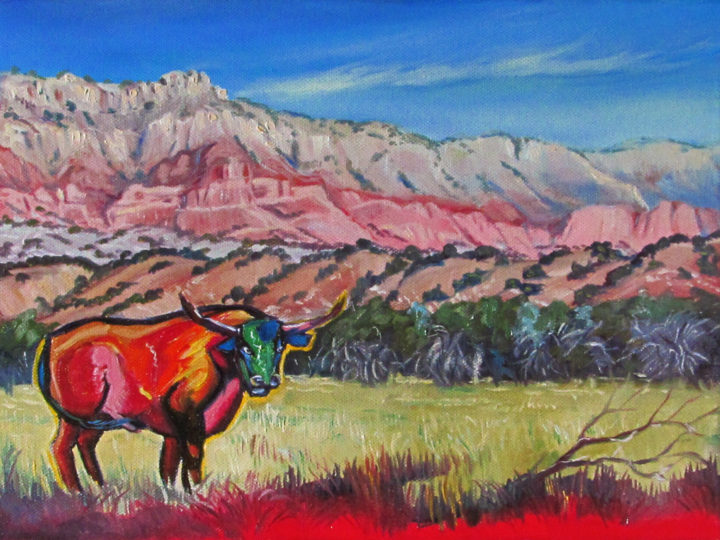
I love painting the Jemez Mountains, and I was looking forward to this painting. I was thinking of making the cow bigger.
Challenge 11 photo
Then it hit me. I decided to pay a little tribute to the late, great John Nieto by placing a Nieto-style cow into a more representational Jemez scene.
The juxtaposition of the bright, semi-abstract cow and the traditionally styled bakground create a spiritual feeling painting
Welcome!
We use cookies on our website to give you the most relevant experience by remembering your preferences and repeat visits. By clicking “Accept”, you consent to the use of ALL the cookies.
This website uses cookies to improve your experience while you navigate through the website. Out of these, the cookies that are categorized as necessary are stored on your browser as they are essential for the working of basic functionalities of the website. We also use third-party cookies that help us analyze and understand how you use this website. These cookies will be stored in your browser only with your consent. You also have the option to opt-out of these cookies. But opting out of some of these cookies may affect your browsing experience.
Necessary cookies are absolutely essential for the website to function properly. These cookies ensure basic functionalities and security features of the website, anonymously.
Cookie
Duration
Description
cookielawinfo-checkbox-analytics
11 months
This cookie is set by GDPR Cookie Consent plugin. The cookie is used to store the user consent for the cookies in the category "Analytics".
cookielawinfo-checkbox-functional
11 months
The cookie is set by GDPR cookie consent to record the user consent for the cookies in the category "Functional".
cookielawinfo-checkbox-necessary
11 months
This cookie is set by GDPR Cookie Consent plugin. The cookies is used to store the user consent for the cookies in the category "Necessary".
cookielawinfo-checkbox-others
11 months
This cookie is set by GDPR Cookie Consent plugin. The cookie is used to store the user consent for the cookies in the category "Other.
cookielawinfo-checkbox-performance
11 months
This cookie is set by GDPR Cookie Consent plugin. The cookie is used to store the user consent for the cookies in the category "Performance".
viewed_cookie_policy
11 months
The cookie is set by the GDPR Cookie Consent plugin and is used to store whether or not user has consented to the use of cookies. It does not store any personal data.
Functional cookies help to perform certain functionalities like sharing the content of the website on social media platforms, collect feedbacks, and other third-party features.
Performance cookies are used to understand and analyze the key performance indexes of the website which helps in delivering a better user experience for the visitors.
Analytical cookies are used to understand how visitors interact with the website. These cookies help provide information on metrics the number of visitors, bounce rate, traffic source, etc.
Advertisement cookies are used to provide visitors with relevant ads and marketing campaigns. These cookies track visitors across websites and collect information to provide customized ads.